Syllabus: REST Assured Learning Guide
REST Assured is a popular Java tool that makes testing web APIs simple and easy to read. This learning guide walks you through practical examples to show you how to send requests, check responses, and build reliable automated API tests.
How to Use This Guide
Each section links to a guide that explains the theory, introduces the API under test and walks through the REST Assured tests. The matching code is in the REST Assured Examples repository, so you can run the tests and change them as you read.
- Beginner: start at Module 1 and work through in order.
- Intermediate: start at Module 4.
- Advanced: jump to the modules you need from Module 7 onwards.
Looking for one topic? Use the search box or scan the tables below.
Course Modules
Work through the modules in order. They build on each other conceptually, but their code is independent, so you can also run any module on its own. The code for every module is in the REST Assured Examples repository on GitHub.
| Module | Level | Topics |
|---|---|---|
| 1. Foundations | Beginner | given/when/then, where requests go, first assertions, logging, reading failures |
| 2. Building requests | Beginner | Parameters, headers, cookies, bodies, every HTTP method, multipart |
| 3. Validating responses in depth | Beginner to Intermediate | GPath, root paths, money as BigDecimal, Hamcrest, cookies, XML and HTML |
| 4. Extracting values and mapping objects | Intermediate | extract(), JsonPath, records, TypeRef, Jackson 3, chaining |
| 5. Reusable specifications and configuration | Intermediate | Specifications, RestAssuredConfig, timeouts, redirects, log masking, a JUnit extension |
| 6. Schema and contract validation | Intermediate | JSON Schema 2020-12, RFC 9457, ISO 20022 XSD, an OpenAPI contract filter |
| 7. Authentication and transport security | Intermediate to Advanced | Basic, bearer, client credentials, negative security tests, sessions, mutual TLS, redirects |
| 8. Filters and extensibility | Advanced | Custom filters, HTTP message signatures, log masking, custom authentication, parsers, listeners |
| 9. Data-driven tests and API workflows | Advanced | Parameterized and dynamic tests, workflows, idempotency, ETags, pagination, polling |
| 10. Stubbing dependencies with WireMock | Advanced | Stubs, faults, verifying outgoing calls, templates, scenarios |
| 11. Spring Boot integration | Advanced | RestAssuredMockMvc, Spring Security, random-port servers, version alignment |
| 12. Real infrastructure with Testcontainers | Advanced | Keycloak tokens, parallel execution, tags and profiles |
Module 1: Foundations
How a REST Assured test is put together, where its requests go, how to check a response, and how to read what happens when a check fails. The tests run against an Accounts API. See the Module 1 README for the code and how to run it.
| Section | Guide | What you will learn |
|---|---|---|
| 1 | Send Your First REST Assured Request | Start a real HTTP API with @BeforeAll, send a request with given/when/then, and check the status code and JSON body |
| 2 | Take Apart a REST Assured Test | The three types behind given/when/then, the syntactic sugar, the shorter forms, stored responses and a first path parameter |
| 3 | Control Where REST Assured Requests Go | How a URL is built from baseUri, port, basePath and the path, when an absolute URL wins, and why static defaults are global state |
| 4 | Check Every Part of an HTTP Response | Status codes and lines, content types, case-insensitive headers, GPath body paths, lists, Float numbers, problem details and response time |
| 5 | Log REST Assured Requests and Responses | Logging everything, single parts, only when validation fails, only for errors, or only for one status code |
| 6 | Read REST Assured Failure Messages | The shape of a failure message, why a then() chain stops at its first failure, and how one body(..) call reports every mismatch |
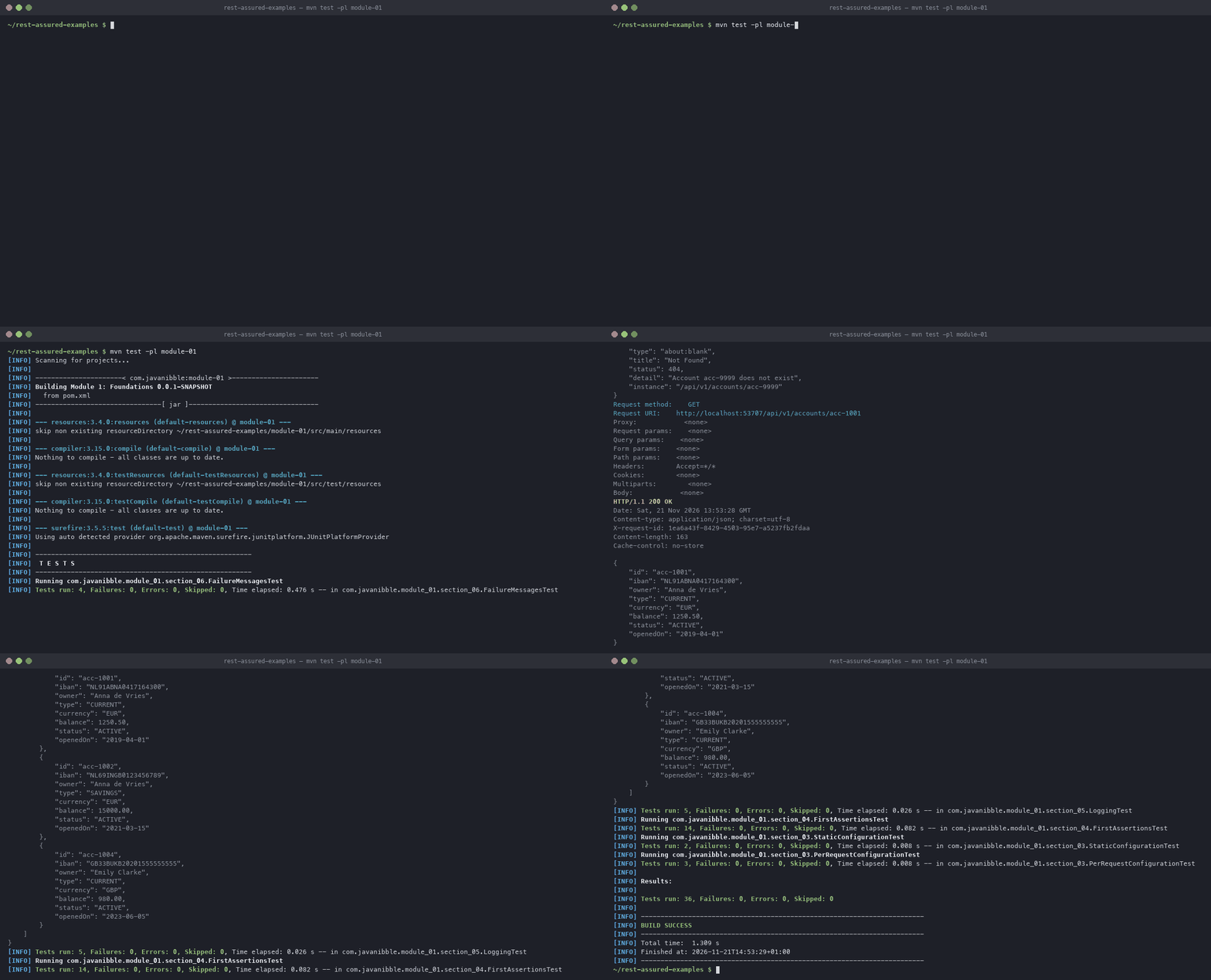 Module 1: Build & Test Results
Module 2: Building Requests
Every way to put data into a request, and how to send every HTTP method. The tests run against a Payments API with echo endpoints that show exactly what was sent. See the Module 2 README for the code and how to run it.
| Section | Guide | What you will learn |
|---|---|---|
| 1 | Fill Path Parameters in REST Assured | Named and unnamed path parameters, mixing the two, URL encoding, and finding a resource through its Location header |
| 2 | Send Query and Form Parameters in REST Assured | Multi-value and empty query parameters, java.time values, form bodies, turning URL encoding off, and where param(..) puts its value |
| 3 | Send Headers and Cookies in REST Assured | Headers from maps and objects, merging versus overwriting, accept(..), the charset added to text types, and cookies |
| 4 | Send Request Bodies in REST Assured | Which bodies are sent as they are and which are serialized, records as typed bodies, and testing 422 and 415 rejections |
| 5 | Send Every HTTP Method in REST Assured | Replacing, patching and cancelling a resource, HEAD, OPTIONS, the new QUERY method, custom methods and 405 |
| 6 | Upload Files With Multipart Requests in REST Assured | Uploading a file with a text field from a File, from bytes and with MultiPartSpecBuilder, and testing a missing part |
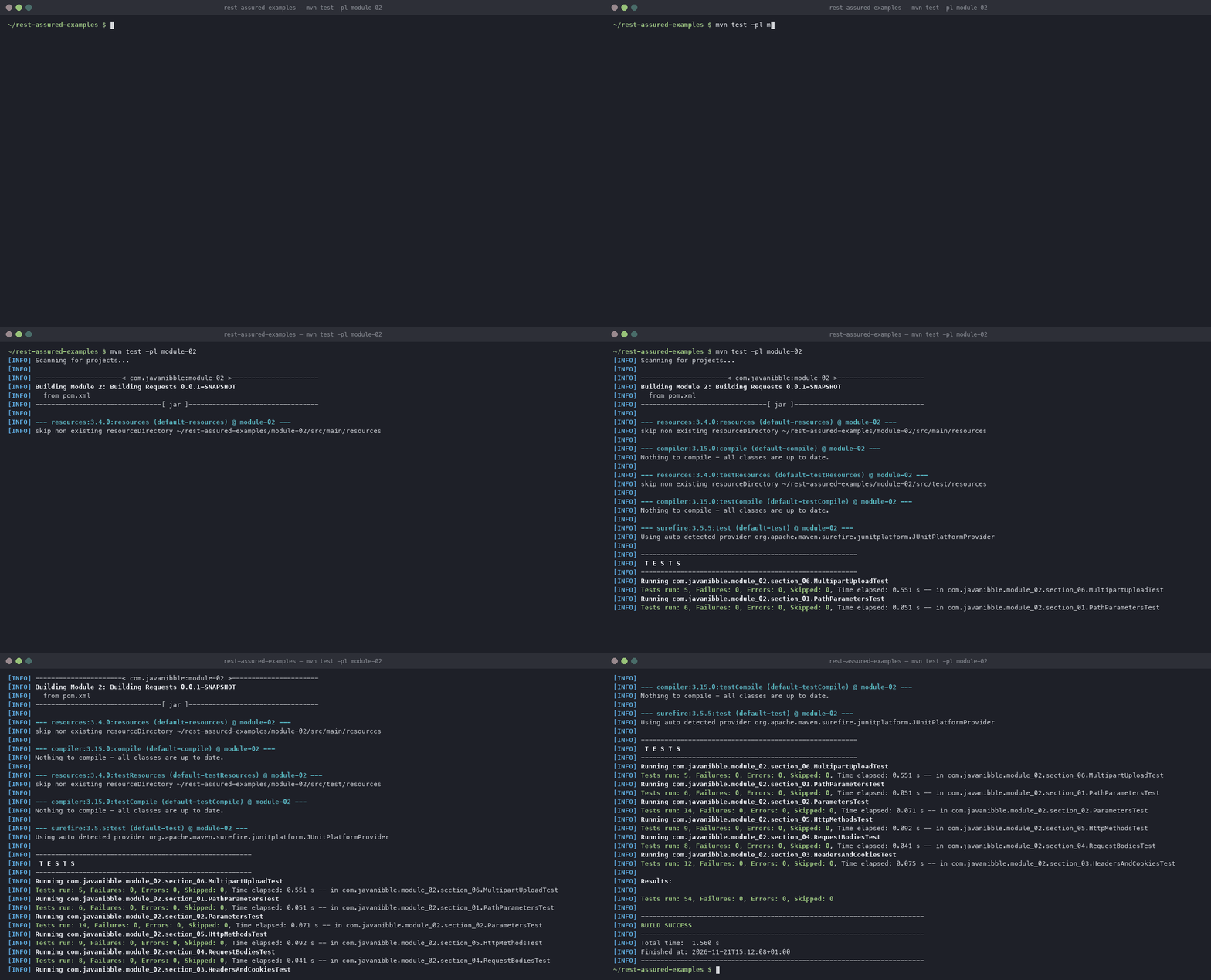 Module 2: Build & Test Results
Module 3: Validating Responses in Depth
How to check any part of a response precisely: GPath for JSON, root paths, numbers and money, the Hamcrest matchers you will use most, response-aware matchers, cookies and their security attributes, and XML and HTML. The tests run against a Transactions API with one account and a month of transactions. See the Module 3 README for the code and how to run it.
| Section | Guide | What you will learn |
|---|---|---|
| 1 | Filter JSON Lists With GPath in REST Assured | Filtering and transforming lists with Groovy closures, any and every, max and min, ranges, flatten(), keys with dashes and a JSON array at the root |
| 2 | Shorten JSON Paths With Root Paths in REST Assured | Removing the repeated start of a path with rootPath(..), moving it during a chain, and reusing one path for many values with withArgs(..) |
| 3 | Check Money Exactly With BigDecimal in REST Assured | How JSON numbers are read, why Float can’t hold money, BigDecimal with JsonConfig, comparesEqualTo versus equalTo, exact sums and closeTo |
| 4 | Pick the Right Hamcrest Matcher in REST Assured | The difference between hasItems, contains and containsInAnyOrder, map and string matchers, and combining matchers with allOf, anyOf, oneOf and not |
| 5 | Check Server-Generated Values With Response-Aware Matchers | Checking values the server chooses, such as a new id in the Location header, with a lambda or endsWithPath(..), and one body value against another |
| 6 | Check Session Cookie Security in REST Assured | Checking cookie values and the Secure, HttpOnly, SameSite, Path and Max-Age attributes of a session cookie, and reading a Cookie object |
| 7 | Check XML and HTML Responses in REST Assured | XML paths and attributes, find and findAll on elements, depth-first search with **, namespaces with declareNamespace(..), and lenient HTML |
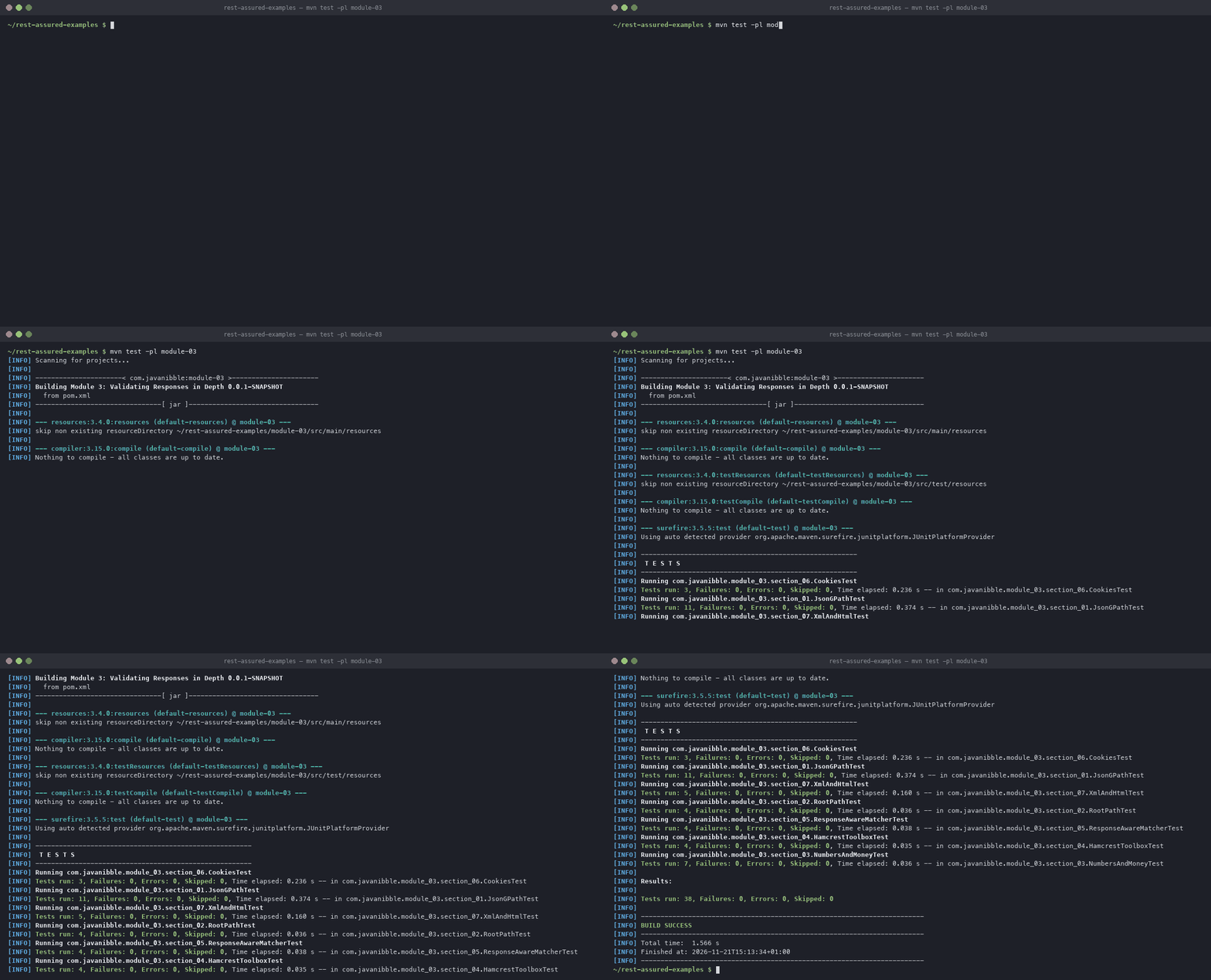 Module 3: Build & Test Results
Module 4: Extracting Values and Mapping Objects
How to get data out of responses, as single values or as Java records, how to configure the object mapper, and how to chain requests in which each step uses what the previous one returned. The tests run against a Customers and Consents API modelled on open banking account access consents. See the Module 4 README for the code and how to run it.
| Section | Guide | What you will learn |
|---|---|---|
| 1 | Extract Values From a Response in REST Assured | Extracting a value, a list, headers and the whole response, using a value in the next request, and why you validate before you extract |
| 2 | Read Many Values With JsonPath and XmlPath in REST Assured | Typed getters that convert values, maps and mapped objects, and reading JSON and XML that didn’t come from an HTTP call |
| 3 | Map Responses to Java Records in REST Assured | Mapping bodies to records with as(..), generic types with TypeRef, unknown fields in Jackson 3, and AssertJ assertions on records |
| 4 | Configure the Object Mapper in REST Assured | Choosing a mapper with ObjectMapperType, the lenient default, a strict JsonMapper, and the 6.3 factory interfaces |
| 5 | Chain Requests Into an API Flow in REST Assured | Following Location headers and _links, the full consent flow from customer to balances, and testing what a consent must refuse |
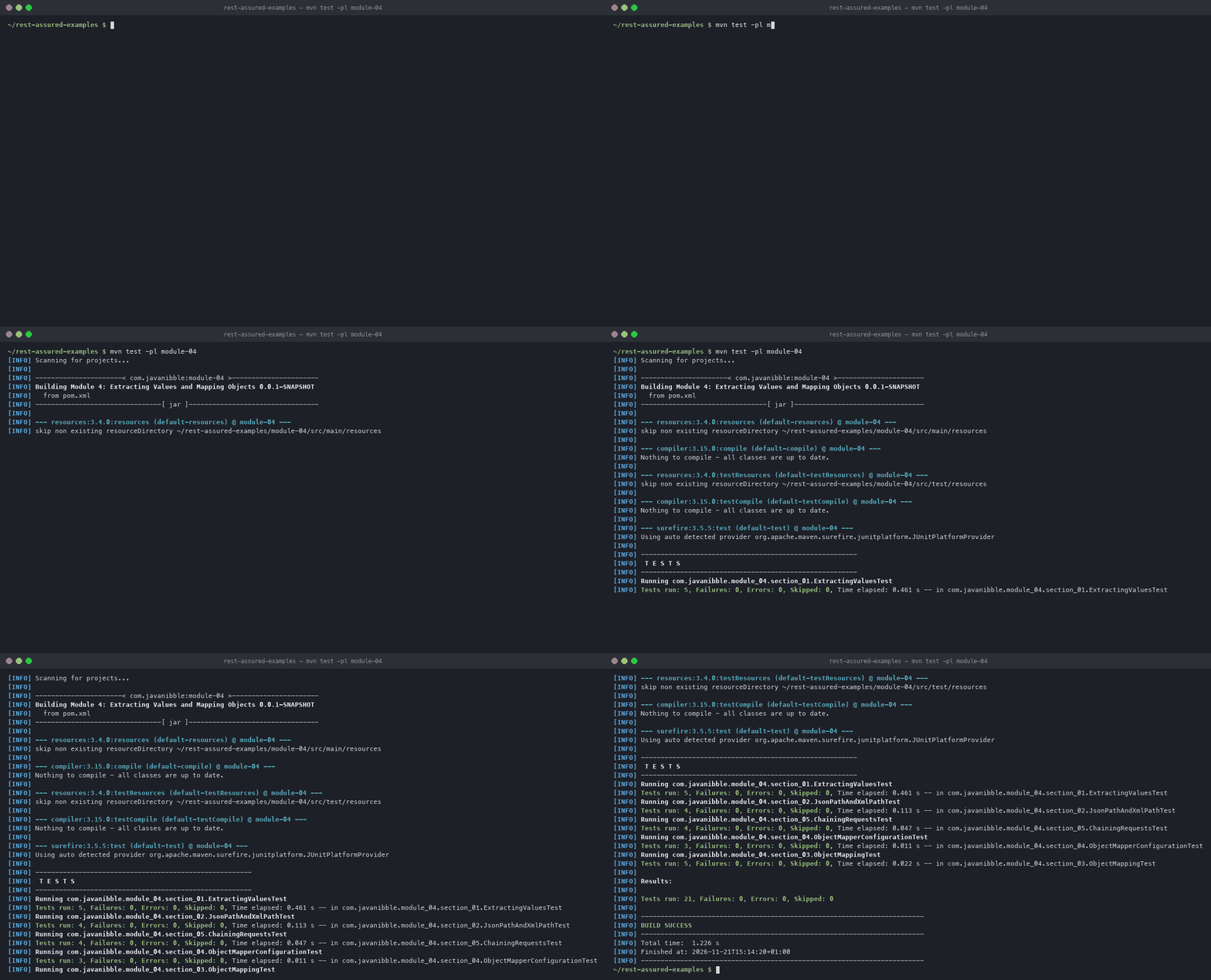 Module 4: Build & Test Results
Module 5: Reusable Specifications and Configuration
How to remove repetition from a suite and configure REST Assured safely: request and response specifications, RestAssuredConfig, keeping secrets out of logs, and a JUnit 6 extension that replaces static configuration. The tests run against an account information API in the style of the UK Open Banking standard. See the Module 5 README for the code and how to run it.
| Section | Guide | What you will learn |
|---|---|---|
| 1 | Build Reusable Request Specifications in REST Assured | Building and layering request specifications, testing without credentials, overriding a header with HeaderConfig, and inspecting a specification |
| 2 | Share Response Checks With Response Specifications in REST Assured | Shared expectations for success and errors, then().spec(..) and given(request, response), and why a specification reports every failure at once |
| 3 | Configure Timeouts, Redirects and Charsets in REST Assured | Connect and read timeouts with Duration, following redirects for GET, POST and all methods, and setting the default charset for decoding |
| 4 | Keep Secrets Out of REST Assured Logs | Masking Authorization and Cookie headers with blacklistHeader(..), masking when logging on failure, and testing what was logged |
| 5 | Inject REST Assured Specifications With a JUnit Extension | A JUnit 6 extension that starts the API per class, injects specifications as parameters, and closes the API through the extension store |
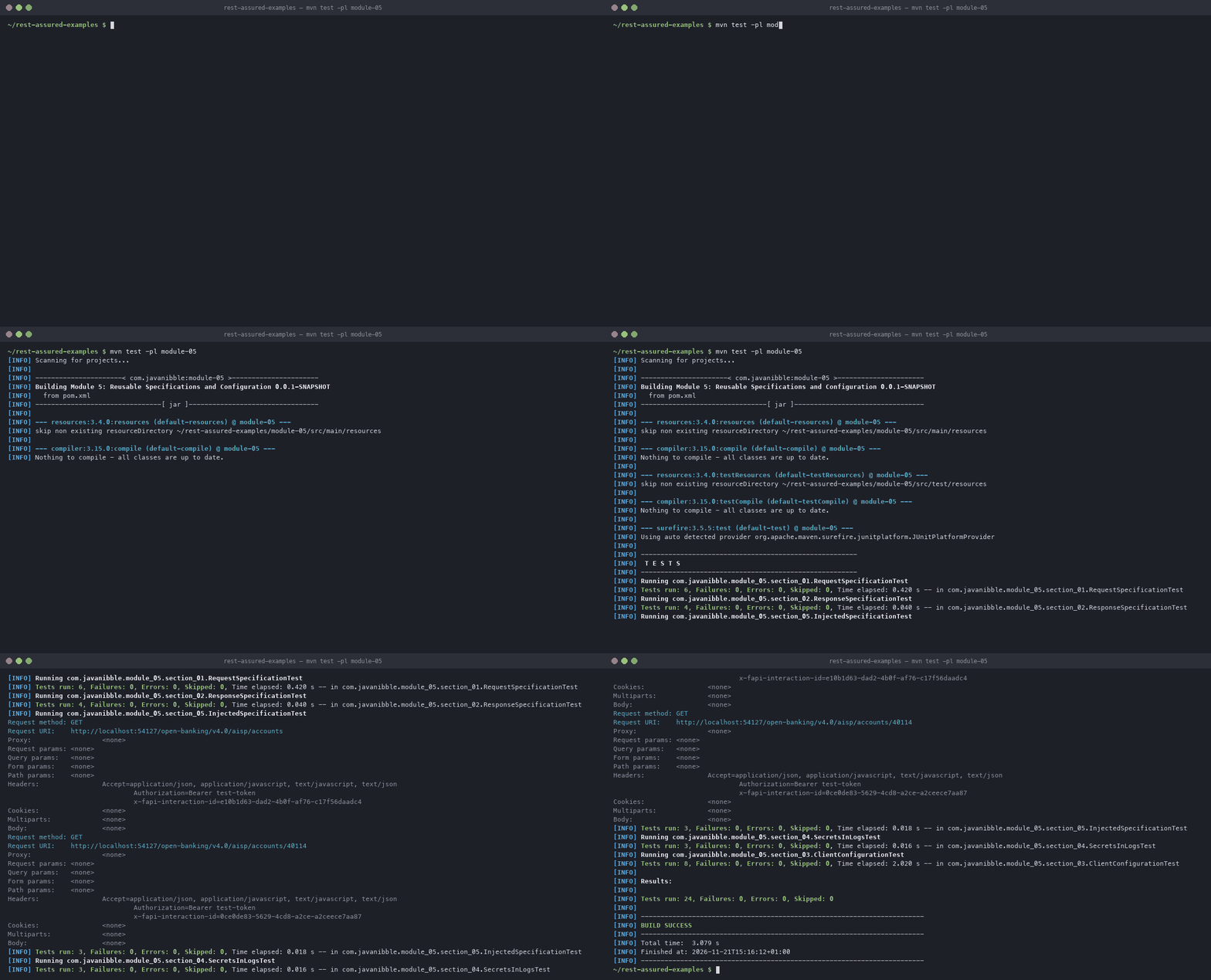 Module 5: Build & Test Results
Module 6: Schema and Contract Validation
How to check the shape of responses instead of single values: JSON Schema 2020-12, a shared contract for errors, XML Schema for ISO 20022 messages, and checking every response against an OpenAPI description. The tests run against a payment initiation API in the style of PSD2. See the Module 6 README for the code and how to run it.
| Section | Guide | What you will learn |
|---|---|---|
| 1 | Validate Responses Against a JSON Schema in REST Assured | Validating whole responses against a draft 2020-12 schema, what a schema catches that value checks miss, inline schemas, and validating JSON without HTTP |
| 2 | Test an RFC 9457 Error Contract in REST Assured | One problem schema for every error, if/then/else so a 422 must list its field errors, and testing the schema itself |
| 3 | Validate ISO 20022 XML Against an XSD in REST Assured | Validating payment files and status reports with matchesXsdInClasspath(..), checking test data, and handling the SAXParseException of an invalid document |
| 4 | Check Every Response Against OpenAPI With a REST Assured Filter | A filter that checks every operation, status and body against an OpenAPI 3.1 description, and the difference between contract and functional tests |
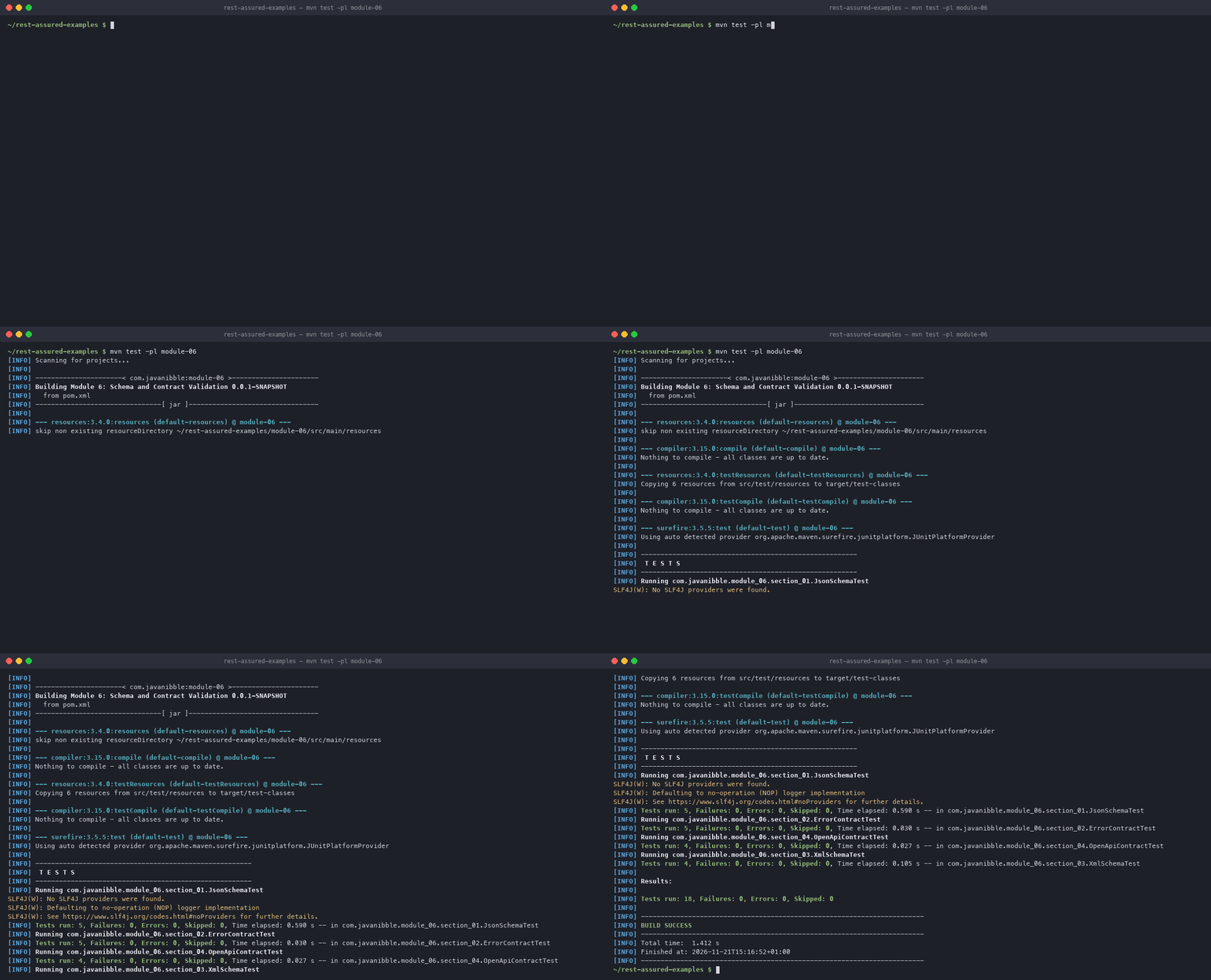 Module 6: Build & Test Results
Module 7: Authentication and Transport Security
How to test protected APIs, including everything that must happen when credentials are missing, wrong or not enough: Basic authentication, OAuth 2.0 bearer tokens, the error responses of RFC 6749 and RFC 6750, sessions with CSRF, TLS and mutual TLS, and credentials on redirects. The tests run against an OAuth 2.0 authorization server and the resource server it protects. See the Module 7 README for the code and how to run it.
| Section | Guide | What you will learn |
|---|---|---|
| 1 | Test HTTP Basic Authentication in REST Assured | The 401 challenge, challenged and preemptive Basic, why challenged Basic fails against a server that never challenges, and wrong credentials |
| 2 | Get and Send OAuth 2.0 Bearer Tokens in REST Assured | Getting a token with the client credentials grant, client_secret_basic and client_secret_post, sending it with auth().oauth2(..), and reading JWT claims |
| 3 | Write Negative Security Tests for OAuth 2.0 in REST Assured | Token endpoint errors, WWW-Authenticate responses for missing, expired, wrong-audience and tampered tokens, 401 versus 403, and a missing scope |
| 4 | Test a Session Login With CSRF in REST Assured | Reading a CSRF token with htmlPath(), keeping a session with a SessionFilter, setting the session id explicitly, and a missing or reused CSRF token |
| 5 | Test HTTPS and Mutual TLS in REST Assured | Why relaxedHTTPSValidation() is the wrong fix, trusting a certificate with a trust store, presenting a client certificate, and passing a JDK SSLContext |
| 6 | Keep Credentials Off Cross-Origin Redirects in REST Assured | How REST Assured 6.1 drops Authorization and Cookie on cross-origin redirects, testing what a redirect target receives, and the opt-out |
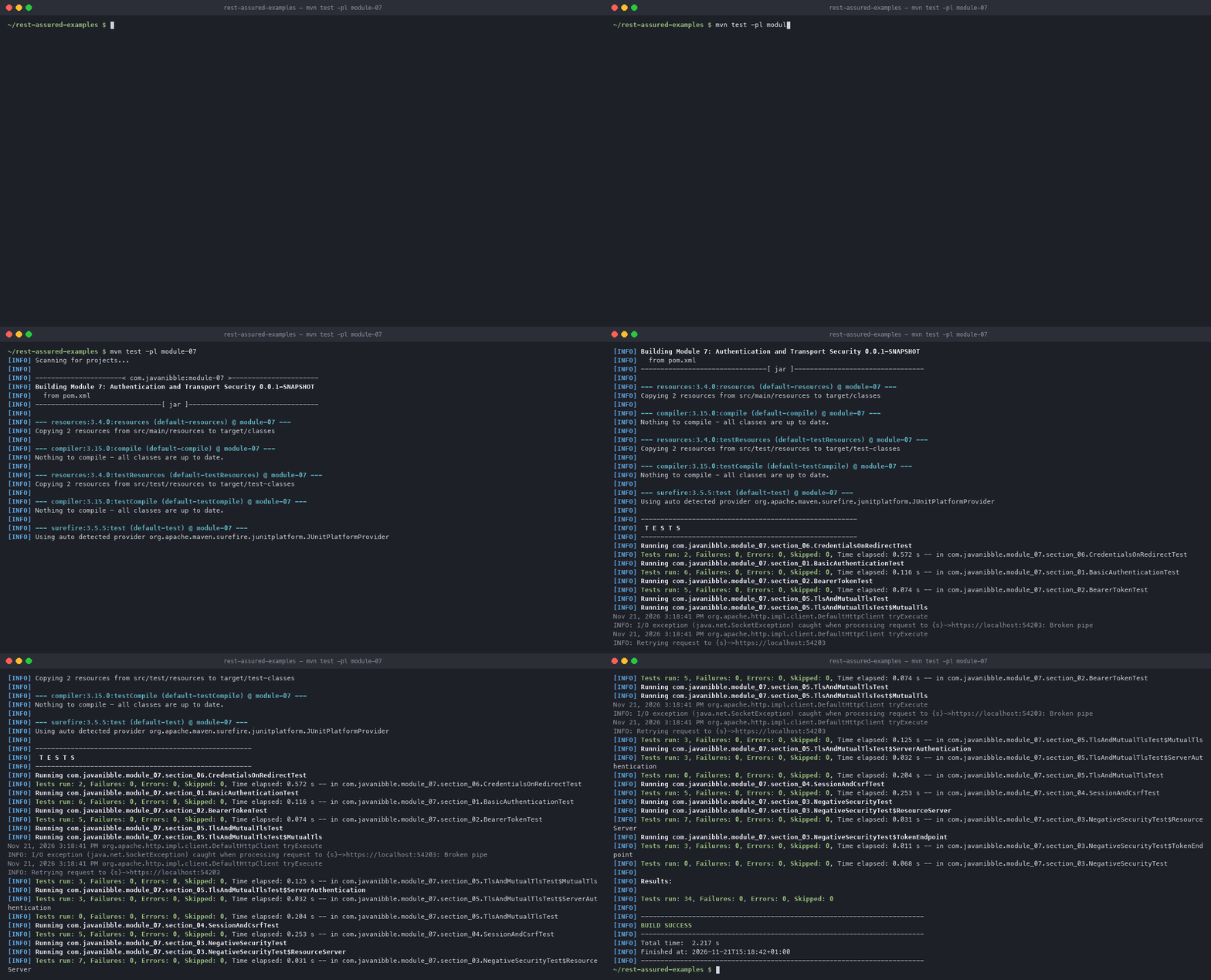 Module 7: Build & Test Results
Module 8: Filters and Extensibility
How to change every request and response in one place with filters, sign requests, mask personal data in logs, write a custom authentication scheme, read misbehaving responses with parsers, and react to failures with listeners. The tests run against a payments API that requires signed requests. See the Module 8 README for the code and how to run it.
| Section | Guide | What you will learn |
|---|---|---|
| 1 | Write Request and Response Filters in REST Assured | Filters that change requests and see responses, lambda filters, filters that fail a test, OrderedFilter, and filters in a specification or globally |
| 2 | Write Timing, Masking and Repair Filters in REST Assured | Timing every exchange, a log with IBANs and names masked, the built-in logging filters, and repairing a response with ResponseBuilder |
| 3 | Sign Requests With HTTP Message Signatures in REST Assured | Signing requests with RFC 9421 and a Content-Digest in a filter that runs last, and proving the server rejects unsigned, tampered, wrongly signed and stale requests |
| 4 | Write a Custom Authentication Scheme in REST Assured | An API key scheme with ContextAuthenticationScheme, removing it with auth().none(), replacing it, and why a scheme beats a header |
| 5 | Use Parsers and Failure Listeners in REST Assured | Reading JSON sent as text/plain with a parser, why a spec’s parser doesn’t reach chained checks, and collecting evidence with a failure listener |
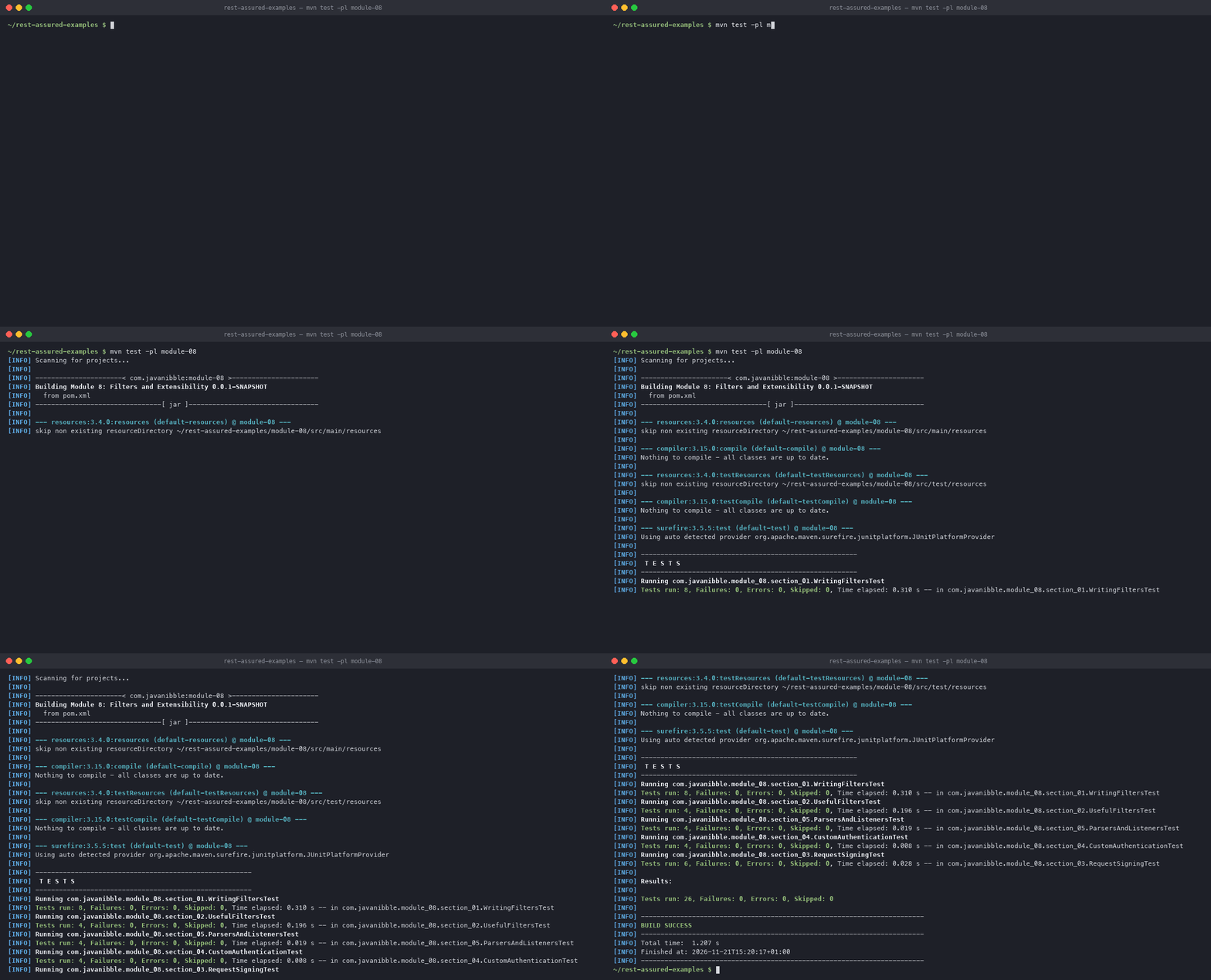 Module 8: Build & Test Results
Module 9: Data-Driven Tests and API Workflows
How to test many inputs without copying tests, generate tests at run time, test multi-step workflows, check the HTTP semantics payment APIs depend on, and wait for asynchronous work. The tests run against a payment lifecycle API, from initiation to execution. See the Module 9 README for the code and how to run it.
| Section | Guide | What you will learn |
|---|---|---|
| 1 | Write Parameterized API Tests With REST Assured | A validation matrix in a @CsvSource text block, boundary values, @FieldSource and @MethodSource, a class per currency with @ParameterizedClass, and logging only failures |
| 2 | Generate Dynamic API Tests With REST Assured | Generating security tests for every endpoint at run time, grouping them with dynamicContainer, and when to choose dynamic over parameterized tests |
| 3 | Test API Workflows With REST Assured | A payment lifecycle as ordered steps sharing one instance, why independent tests are better, and testing the transitions that must be refused |
| 4 | Test Idempotency, ETags and Pagination in REST Assured | Idempotent replay with an Idempotency-Key, 304, 428 and 412 with ETags, and following Link headers through every page |
| 5 | Test Asynchronous APIs With REST Assured | Polling a Location with Awaitility instead of Thread.sleep, respecting Retry-After, and waiting for any final state before checking which one |
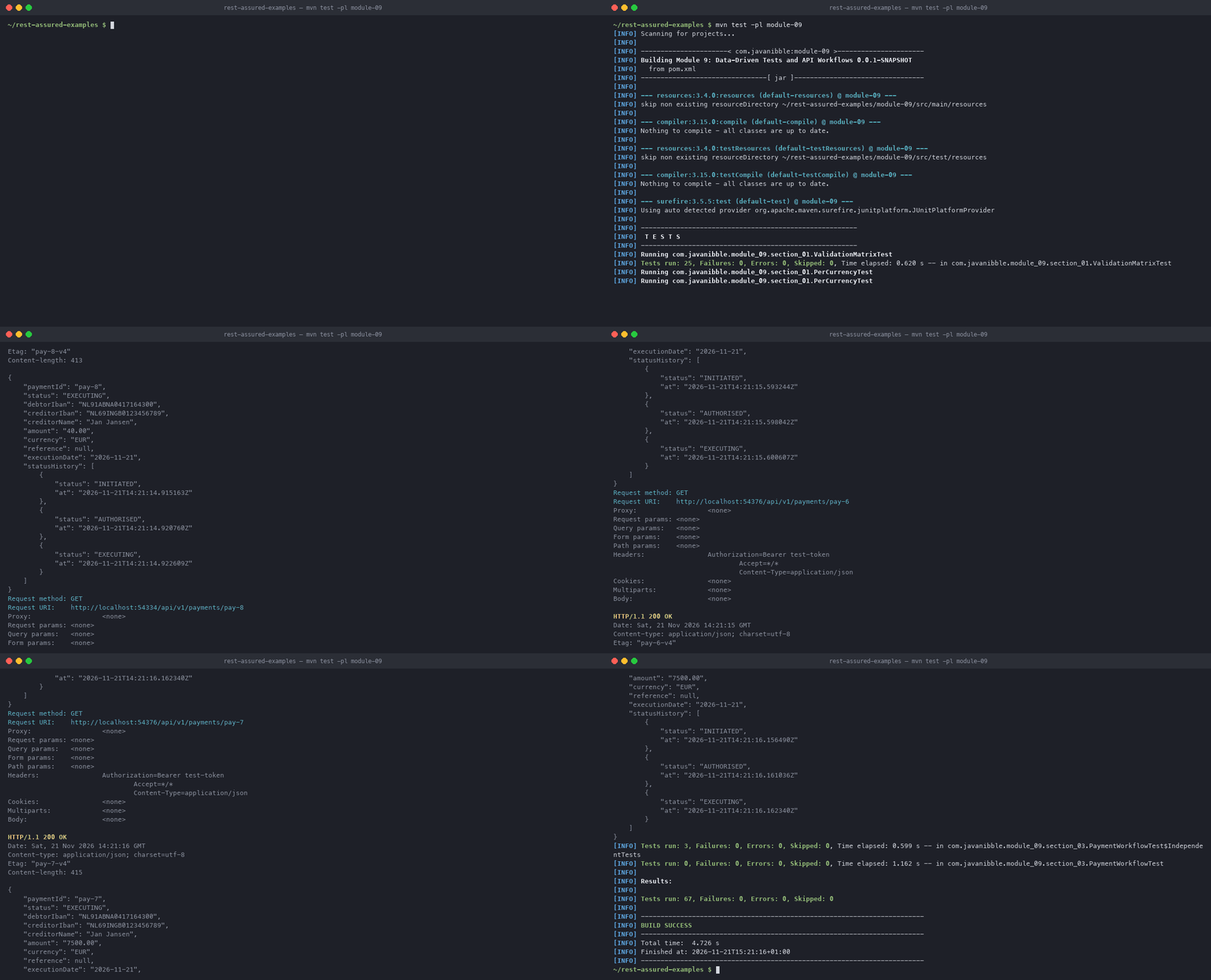 Module 9: Build & Test Results
Module 10: Stubbing Dependencies with WireMock
How to test an API whose own dependency you don’t control: REST Assured calls your API, and WireMock plays the third-party API it calls. The tests run against a quote service that asks an FX provider for exchange rates. See the Module 10 README for the code and how to run it.
| Section | Guide | What you will learn |
|---|---|---|
| 1 | Stub a Dependency With WireMock in REST Assured Tests | WireMockExtension, strict request patterns, a stubbed rate and half-even rounding, unmatched requests, and input that never reaches the provider |
| 2 | Simulate Provider Faults With WireMock in REST Assured Tests | Server errors, delays, reset connections, broken JSON, rate limiting and unknown currencies, and what your API’s clients should see for each |
| 3 | Verify Outgoing Calls With WireMock in REST Assured Tests | verify(..) with exact counts, query parameters and headers, one retry for a 503, no retry for a 500, and reading recorded requests |
| 4 | Use Response Templates and Scenarios in WireMock Stubs | One templated stub for every currency, and scenarios in which the provider fails and recovers, to prove a retry gives up or saves a request |
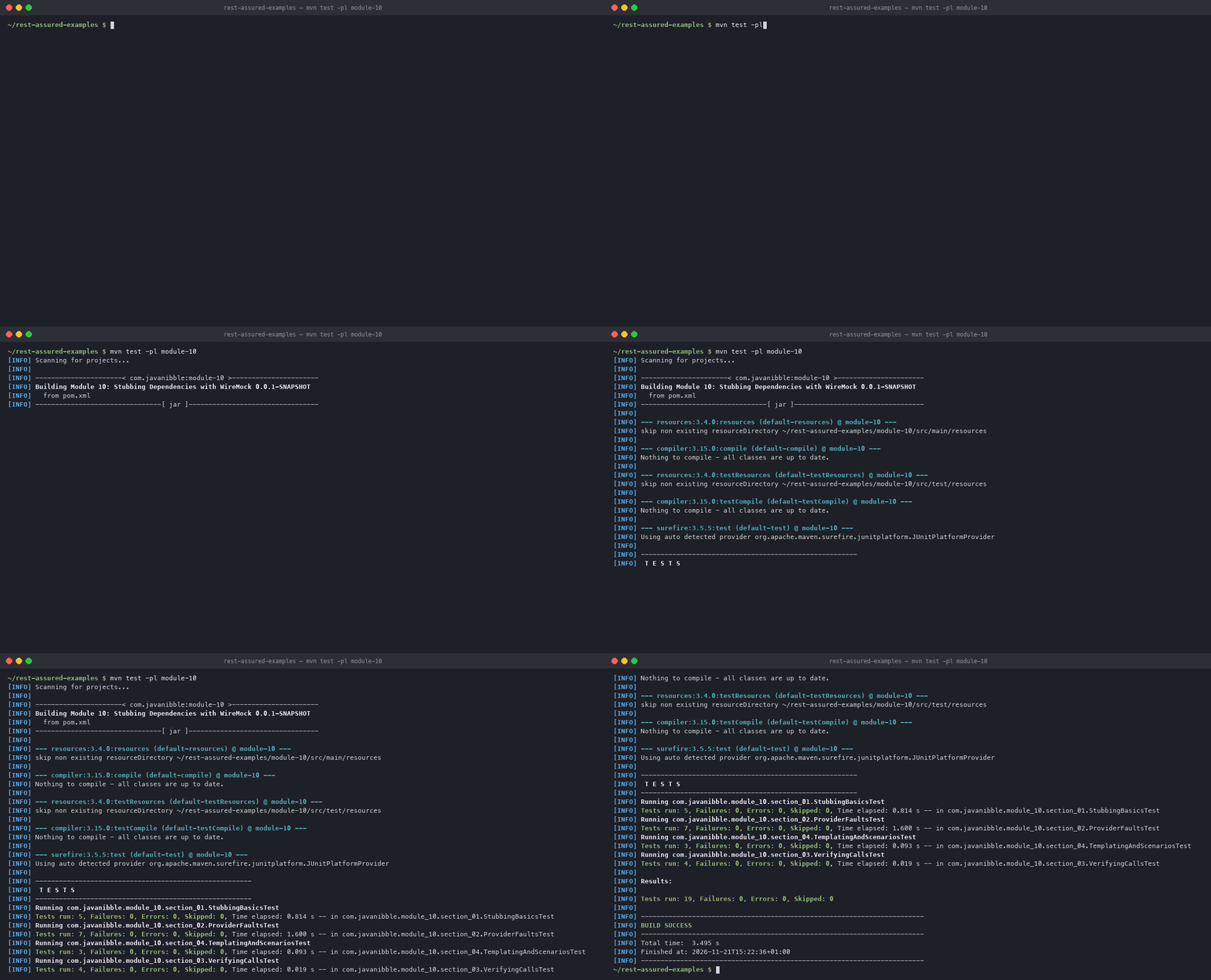 Module 10: Build & Test Results
Module 11: Spring Boot Integration
The ways to test a Spring Boot API with REST Assured: RestAssuredMockMvc without a server, a web slice with Spring Security, and plain REST Assured against the whole application on a random port, plus keeping versions aligned under Spring Boot’s dependency management. The tests run against a Spring Boot 4.1 accounts service secured as an OAuth 2.0 resource server. See the Module 11 README for the code and how to run it.
| Section | Guide | What you will learn |
|---|---|---|
| 1 | Test a Spring Controller With RestAssuredMockMvc in Standalone Mode | Testing a controller with standaloneSetup(..), no server and no Spring context, and what that mode leaves out |
| 2 | Test Spring Security Rules in a Web Slice With RestAssuredMockMvc | Testing the security rules in a @WebMvcTest slice with Spring Security’s jwt() post-processor, 401, 403 insufficient_scope and problem details |
| 3 | Test Spring Boot on a Random Port With REST Assured and Real Tokens | The whole application on a random port over real HTTP, with signed test tokens that check signature, expiry, audience and scope |
| 4 | Keep Versions Aligned Under Spring Boot’s Dependency Management | What Spring Boot 4.1 manages, why the first imported BOM wins, and checking resolved versions with dependency:tree |
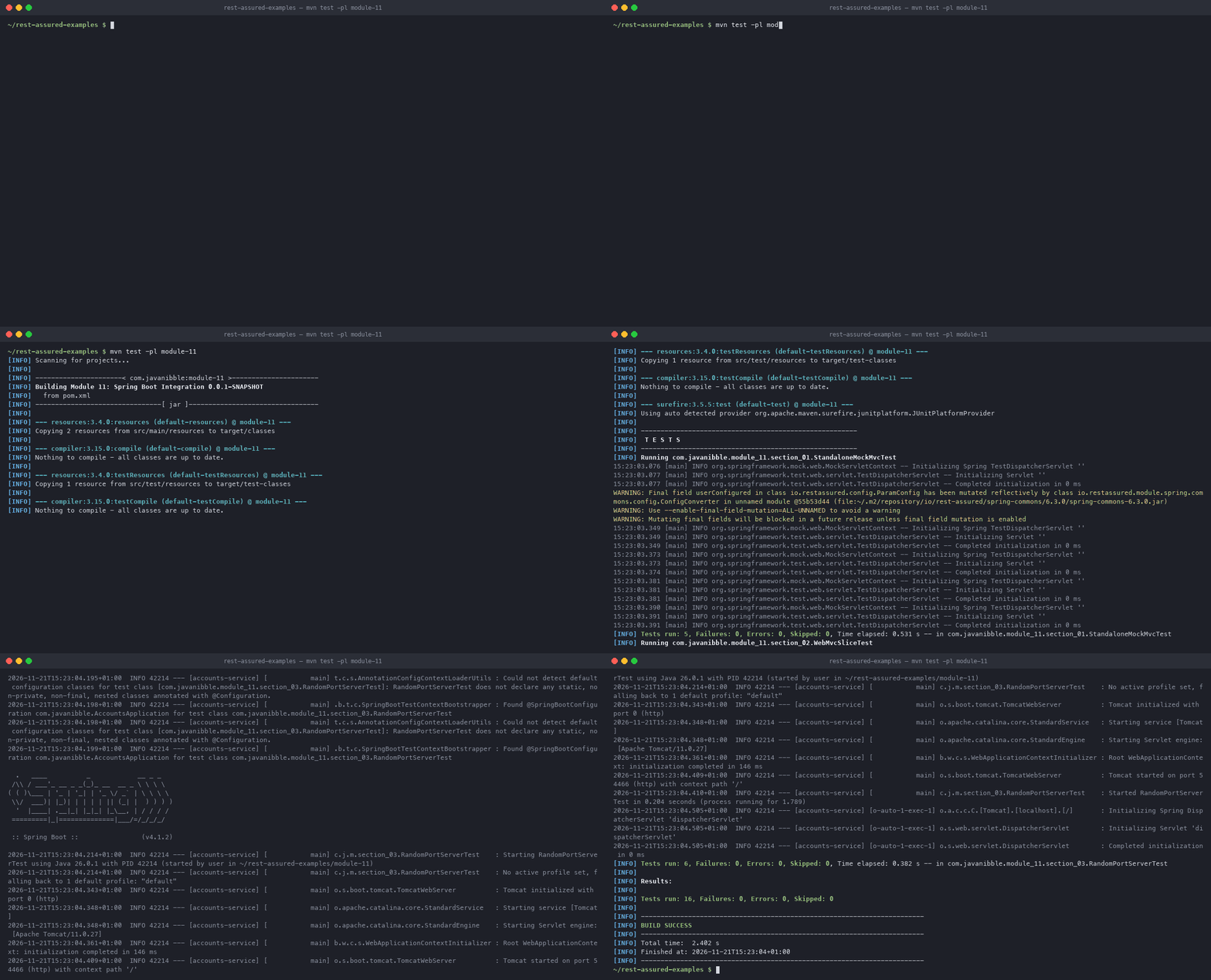 Module 11: Build & Test Results
Module 12: Real Infrastructure with Testcontainers
How to run REST Assured against real infrastructure in Docker, and make a large suite fast and organised: real OAuth 2.0 tokens from Keycloak, parallel execution, and tags with Maven profiles. The tests run against an API protected by a real Keycloak, and a reference data API. The Keycloak tests need Docker. See the Module 12 README for the code and how to run it.
| Section | Guide | What you will learn |
|---|---|---|
| 1 | Test With Real OAuth 2.0 Tokens From Keycloak and Testcontainers | Keycloak in Docker with Testcontainers, OpenID Connect discovery, real tokens with the client credentials grant, and the claims a real server puts in them |
| 2 | Run REST Assured Tests in Parallel With JUnit | Opt-in parallel execution with junit-platform.properties and @Execution(CONCURRENT), and the rules that make REST Assured safe in parallel |
| 3 | Run the Right Subset of a REST Assured Suite With Tags and Maven Profiles | Tags and a composed @SmokeTest, Maven profiles that set groups and excludedGroups, tag expressions, and a suite in a pipeline |
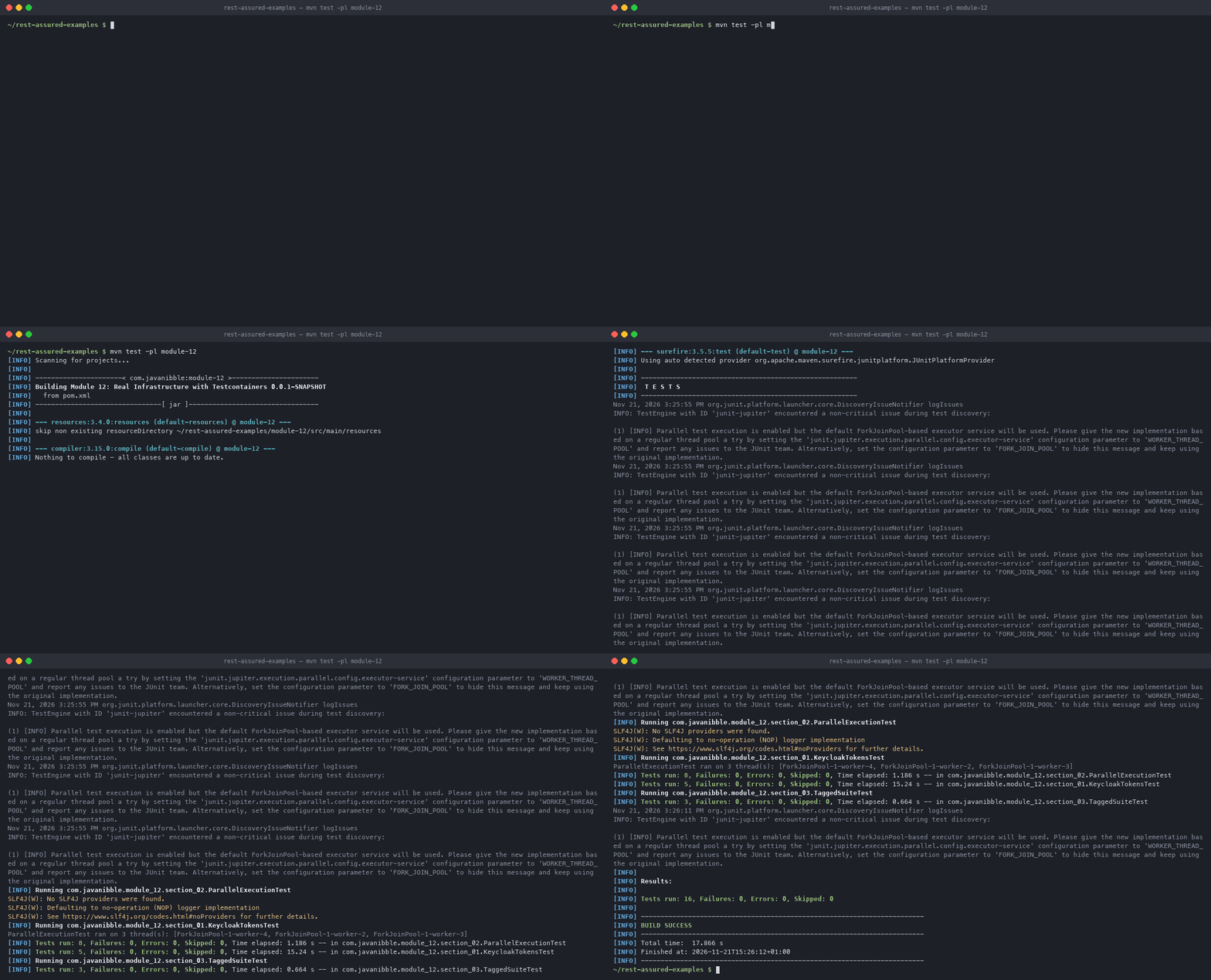 Module 12: Build & Test Results